As an Amazon Associate I earn from qualifying purchases. This post contains affiliate links. If you buy through them we may earn a commission at no extra cost to you.
Product prices and availability are accurate as of the date and time indicated and are subject to change. Any price and availability information displayed on Amazon at the time of purchase will apply to the purchase of this product. Certain content that appears on this site comes from Amazon. This content is provided "as is" and is subject to change or removal at any time.
A loft bed with stairs is bought for one of two reasons — floor space, or a child who should not be on a ladder — and those two reasons want different beds. Worth knowing which one you are before you shop.
The mistake this category punishes hardest is measuring the bed and not the room. A loft bed is the rare piece of furniture where the ceiling is a specification.
Measure the ceiling, then the mattress


Your child has to be able to sit up in the top bunk without hitting their head. That clearance is what decides whether a loft bed is pleasant or something they resent, and it is set by three things stacked together: the height of the bed frame’s sleeping platform, the thickness of the mattress on it, and your ceiling.
Mattress thickness is the part people forget, and it causes a second, more serious problem. Guardrails are designed to stand proud of the mattress surface — US CPSC guidance for bunk beds is that guardrails should extend at least 5 inches above the top of the mattress. Put a thick mattress on a frame designed for a thin one and you quietly lower that margin toward nothing, on a bed several feet off the floor.
So: measure ceiling height, subtract the platform height, subtract your mattress thickness, and see what is left to sit up in. If the answer is tight, a junior or low loft is the honest choice rather than the full-height one you wanted.
The measurement that decides it
Can they sit up in bed?
Stairs cost floor space — that is the trade


Stairs are safer and far easier for a younger child, particularly half asleep at night, and they usually bring storage: drawers in the treads, a chest built into the staircase.
They also consume a surprising amount of room. A ladder is nearly vertical and takes up almost nothing; a staircase runs out into the room, and on many designs it runs out sideways as well. The staircase is often the widest part of the bed, not the mattress. Sketch the footprint on the floor with masking tape before ordering — including the swing of the bedroom door.
Note also that most stairway lofts are handed: the stairs are on the left or the right and cannot always be swapped. Check that against which wall you have.
US CPSC guidance
What to check on the bed itself
2 Age of the child sleeping up top
3 Staircase footprint
4 Which side the stairs are on
5 Slat support under the mattress
- 1At least 5 inches proud of the mattress top, measured with the mattress you actually own — not the thin one it was designed around.
- 2No children under 6 in an upper bunk. The clearest single rule in this category, and the reason junior heights exist.
- 3Often the widest part of the bed, not the mattress. Tape the whole footprint on the floor, and swing the bedroom door over it.
- 4Most stairway lofts are handed and cannot always be reversed. Check it against the wall you have.
- 5Some frames need a bunkie board for the mattress you own. Rarely obvious from the listing, and the commonest cause of a wobbly first night.
Who should not be up there at all


US CPSC guidance is that children under 6 should not sleep in an upper bunk. That is the clearest single rule in this category, and it is the reason low and junior lofts exist — they give a younger child the den underneath and the storage without the height.
If your child is under six and you want a loft, buy a junior height. If they are older, the full-height options open up and the deciding factor goes back to the ceiling.
Height bands
Which loft, for which child and which ceiling
- Junior / low loftUnder 6, or a low ceiling. Buys safety and headroom by giving up the space underneath.
- Mid loftSchool age, standard ceiling. Room for a desk or storage below without losing sitting-up height.
- Full loftOlder child, tall ceiling. Maximum usable floor beneath — and the least margin above.
- Twin over fullTwo children, or sleepovers. The largest thing here in every dimension; it will dominate the room.
The eight, and who each is wrong for


1. Twin Doll House Stair Step Loft
Themed, playful, aimed squarely at younger children who want the space underneath to be a place rather than storage.
Skip it if you want furniture that survives the child outgrowing the theme. A themed bed has a shorter useful life than a plain one, which is fine if you know it going in.
2. Donco Junior Loft Bed With Stairs
Junior height with stairs — the combination that suits a smaller child and a lower ceiling at once.
Skip it if your goal was maximum usable space beneath. Junior height buys safety and headroom by giving up exactly that.
3. DHP Junior Loft Bed
Metal-framed and lower, in the same junior category. Metal frames are generally lighter to move and less forgiving of an imperfect assembly.
Skip it if you want the warmth of a wood frame or intend to build furniture into the space below.
4. Twin Over Full Modular Stairway Loft Bed With Chest
Twin over full is the configuration for siblings of different sizes, or for a child who has sleepovers — the lower full bed takes an adult.
Skip it if your room is small. This is the largest thing on the page in every dimension and it will dominate the room.
5. Canwood Mountaineer Loft Bed with Storage Tower
Loft plus dedicated storage tower — the answer when the loft is really a strategy for a room with no wardrobe.
Skip it if you already have storage. You are paying for the tower and giving it floor space.
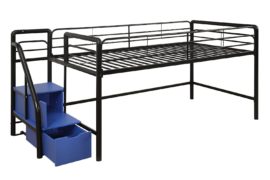
6. DHP Junior Loft With Storage Steps
Storage in the stair treads, which is the most efficient version of this idea: the steps have to exist anyway, so the drawers are free floor space.
Skip it if your child is small enough that drawer-fronted steps become footholds for climbing where you would rather they did not.
7. Discovery World Furniture Twin over Full Loft Bed, Merlot
8. Twin over Full Loft Bed in Merlot Finish
Solid-wood twin-over-full in a dark finish, for a room where the bed is meant to look like furniture rather than a play structure.
Skip both if you will be moving house soon. Solid wood twin-over-full beds are heavy, and they are assembled in the room they live in.
What the low reviews are actually about
Almost never the design. The pattern across this whole category:
- Assembly. These arrive as large flat packs with a lot of hardware and long instructions. Two people and an afternoon is the realistic expectation, not one person and an hour.
- Hardware quality. The commonest specific complaint is a stripped or missing fixing. Worth checking the pack against the parts list before starting rather than discovering it at step forty.
- Slat support. Some frames need a bunkie board or extra slats for the mattress you own; this is rarely obvious from the listing.
- Wobble. Usually under-tightened fixings that need going round again once assembled. Loft beds want re-checking a few weeks in, then periodically.
Before you order
- Ceiling height minus platform height minus mattress thickness — can they sit up?
- Guardrail at least 5 inches above your mattress top, with the mattress you will actually use.
- Tape the full footprint on the floor, staircase included, and open the bedroom door over it.
- Check which side the stairs are on and whether it can be reversed.
- Under 6? Buy junior height.
If the room has two children rather than one, bunk beds with stairs solve a different version of this problem, and toddler bunks for small spaces cover the under-six case. If the goal is a desk underneath rather than storage, loft beds with a desk is the more specific guide.
Where to buy
- CLICK TO CHECK CURRENT PRICE(updated)
- CLICK TO CHECK CURRENT PRICE(updated)
- CLICK TO CHECK CURRENT PRICE
- CLICK TO CHECK CURRENT PRICE(updated)
- CLICK TO CHECK CURRENT PRICE(updated)
- CLICK TO CHECK CURRENT PRICE(updated)
- CLICK TO CHECK CURRENT PRICE(updated)
- CLICK TO CHECK CURRENT PRICE(updated)