
Driving or flying to family with a baby for the holidays? For most trips, the deciding spec isn’t miles or price. It’s how many times your baby has to come out of the car seat, and where. On the road the American Academy of Pediatrics says to take a break every 2 to 3 hours in the daytime. In the air, a lap baby rides free on a domestic flight, but the FAA says the safest place for a child under 2 is an approved car seat in its own seat, which means buying that seat.
I’m Matt. I’m not a pediatrician, and I’m not going to pretend there’s one right answer here. What I can do is put the rules from the AAP, the FAA, the TSA and AAA in one place, show you the math, and tell you who should skip each option. Anything about your own baby’s health goes to your pediatrician, not to me.
The Deciding Spec: Hours in the Car Seat

Start with the AAP’s own answer to whether a baby can ride in a car seat for hours. Its pediatrician writes: “Try to take a break every 2 to 3 hours for a day trip and every 4 to 6 hours at night.” Breaks are for diapers, feeding and a stretch.
Now run your own trip through that. A 6-hour daytime drive means 2 or 3 stops, which is a long lunch and a gas break. A 12-hour drive means 4 to 6 stops by day, and that’s where a one-day drive starts to fall apart. At night the same 12 hours needs only 2 or 3 stops, which is why the AAP suggests that for longer trips you “consider driving at night when your baby is normally asleep for the night.”
Flying flips it. There’s one long stretch in an airport and a plane where the stops aren’t yours to choose. But a 2-hour flight can replace a 9-hour drive, and nobody needs to pull over in Ohio at 2 a.m.
My own rule of thumb (and it’s only that): once a daytime drive needs more than 4 stops at the AAP’s pace, I’d at least price the flight. So count your stops first, and then go look at fares.
Flying: Free on Your Lap, Safer in a Seat

On a domestic flight a baby under 2 usually flies free on your lap. Delta’s infant travel page, for one, says children under 2 can ride on an adult’s lap at no charge within the United States. That’s the big money reason families fly at the holidays.
The FAA doesn’t make you buy a seat. But its Flying with Children page is plain: the safest place for a child under 2 on a U.S. plane is an approved child restraint or device, not your lap. And the National Transportation Safety Board has asked the FAA since 1979 to require a restraint in its own seat for children under 2. That still hasn’t happened, so the call is yours.
So the honest comparison isn’t “free flight against a long drive.” It’s a purchased seat plus a car seat you carry through the airport, against a long drive. Our guide to flying with a baby walks through the whole airport day if you go that way.
The Label That Decides Whether the Car Seat Flies

If you buy the seat, check your car seat before you pack it. The FAA’s advisory circular on child restraints says a seat approved for planes carries a label reading “THIS RESTRAINT IS CERTIFIED FOR USE IN MOTOR VEHICLES AND AIRCRAFT,” in red lettering. No red line, no flying in it. I’d look for it the week before you go, not at the gate. The same circular says seats made between January 1981 and February 1985 carry only a general label, and that alone doesn’t show a seat is approved for planes.
Booster seats are out, because airplane seats only have a lap belt. That’s a spec sheet detail worth knowing if you’ve got a baby and an older sibling. Our post on taking a car seat on a plane has the FAA rules in full.
Driving: The Stops, the Back Seat and the Coat

The same AAP page has a few driving rules worth taping to the dashboard. The car seat needs to be rear-facing and installed at the correct angle, so the baby’s head doesn’t slump into a chin-to-chest position. The harness should be “pulled snug to your baby at all times while riding in the car.”
It says it’s best to have an adult or an older child in the back seat with the baby. It says to know where the gas stations and rest stops are before you leave. And it’s blunt on one point: “Never attempt to breastfeed in a moving car.” Pull over for every feed. Plan the stops around that and the 2-to-3-hour rule mostly takes care of itself.
Winter adds one more thing to check: the coat. Our guide to puffy coats and car seats explains why a bulky coat and a snug harness don’t mix, and what goes on instead. Honestly, I’d check it before every winter drive.
The Crowds: Everyone Else Is Going Too

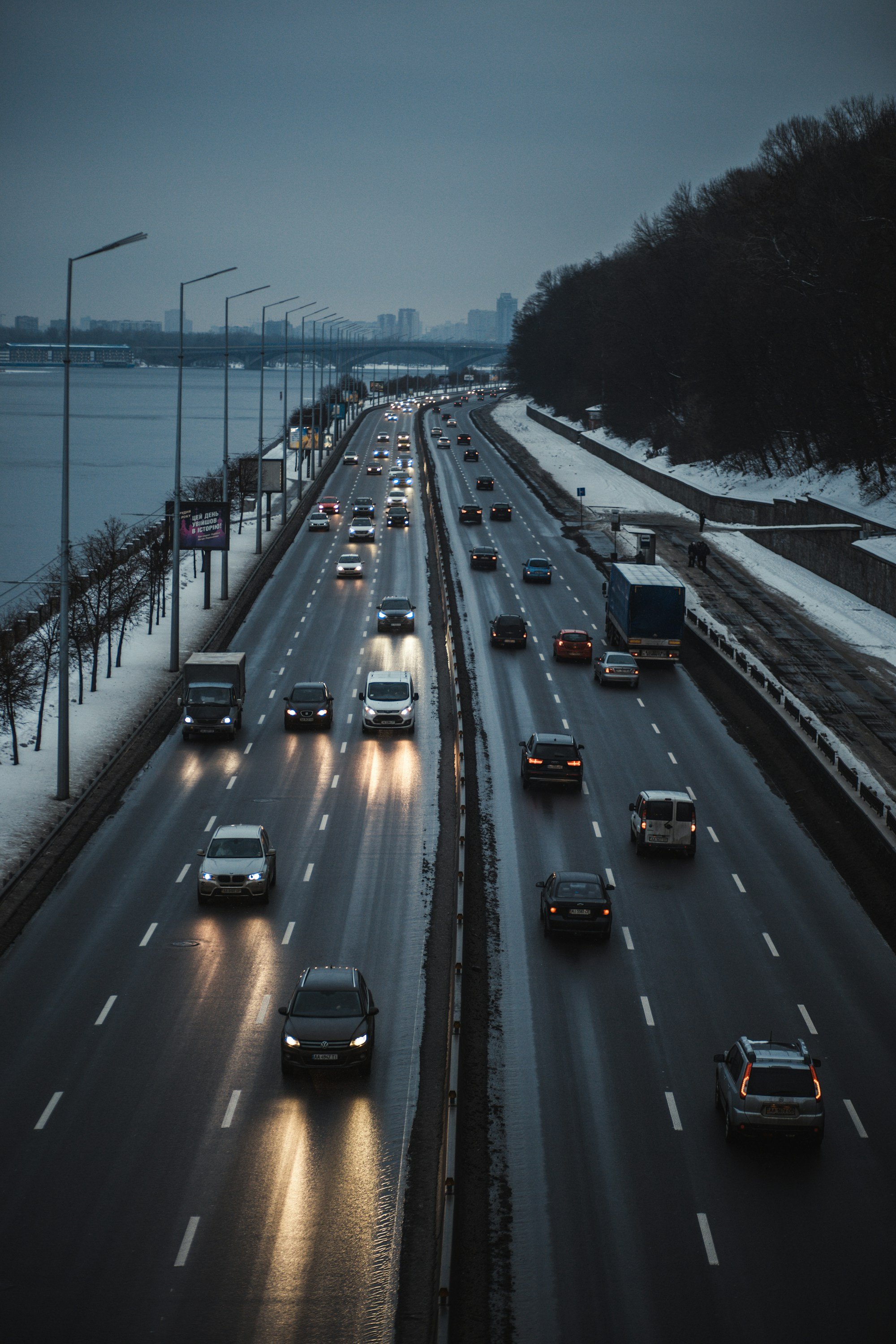
Whichever way you go, you won’t be alone. For Thanksgiving 2025, AAA projected 81.8 million people would travel at least 50 miles from home over the holiday period. At least 73 million of them were expected to go by car, “nearly 90 percent of Thanksgiving travelers.” About 6 million were expected on domestic flights.
The airports still set records. The TSA screened 3,133,924 people (about 3.13 million) on Sunday, November 30, 2025 (the Sunday after Thanksgiving), the most in a single day in its history. Over the week from November 25 to December 1 it screened more than 18 million. AAA’s forecast for 2026 wasn’t out when I checked, so these are last year’s numbers, and the pattern tends to repeat.
What that means for you: if you’re flying, the Sunday after Thanksgiving is the one day I’d avoid with a baby. If you’re driving, the roads are where nearly everyone else is, so leave yourself time for the stops plus the traffic.
What Each Trip Makes You Carry

Driving wins on stuff, and honestly it isn’t close. Everything goes in the trunk, and nobody screens your bottles. Flying means every item has to pass a checkpoint and then get carried.
The TSA does let formula, breast milk and baby food through in “reasonable quantities,” more than the usual 3.4-ounce limit. You take them out of the bag and they get screened on their own. Our guide to flying with formula and breast milk has the details. Bringing a stroller? Our post on gate-checking a stroller covers how that works and what tends to get broken.
Where the Baby Sleeps When You Get There
This is the part people plan last, and I think it matters most. The AAP’s road-trip page says “it’s not safe for your baby to sleep in the car seat once you arrive,” and that if you aren’t sure there’s a safe sleep space at your destination, you should “bring a bassinet or portable play yard with you.”
The AAP’s safe sleep guide sets the bar for whatever you use. Baby on the back for every nap and at night. A firm, flat surface, and “any surface that inclines more than 10 degrees isn’t safe.” No pillows, quilts, bumpers or stuffed toys in the sleep space. Share a room, never a bed. The guide also warns the risk of a sleep-related death is up to 67 times higher when a baby sleeps with someone on a couch or soft armchair, which is exactly the spot a tired parent ends up in at Grandma’s at midnight.
That’s why I’d count the play yard as part of the trip, not an extra. Driving, it’s free to bring. Flying, it’s one more checked bag, or a call ahead to see what your family already has. The same guide points to a June 2021 CPSC rule: every infant sleep product has to meet the federal safety standards for cribs, bassinets, portable cribs or play yards. Our travel crib guide is a place to start, and if your baby has a health condition that changes how they should sleep, that’s a question for your pediatrician.
Who Should Skip Flying, and Who Should Skip the Drive
A “best” way to travel that can’t name who it’s wrong for hasn’t been thought through. So here’s mine, for whom each option is the wrong call.
Skip flying if you won’t buy the baby a seat and the lap part bothers you, or if your car seat has no red aircraft label and you’d have to buy a second seat just for the trip. Skip flying on the Sunday after Thanksgiving, too, if you can move it a day.
Skip the drive if it’s more than one day at the AAP’s daytime pace and there’s only one adult in the car, since nobody can sit in the back. And skip the night drive if the driver is the one who was up with the baby at 3 a.m. Kinda obvious when you say it out loud, but that’s the trip that goes wrong.
And if you’re stuck between the two? I’d go back to the first section and count. Stops by day, stops by night, and who’s in the back seat. That count settles more of these than the price does, in my view.
Everyone else? Either one works. Pick the one with fewer car seat hours and a safe crib at the end, and you’ve made the right call for your family.